


Download brochure
For further information about the M&W Cross Stream Sampler, download the brochure here.

CSS Standard with rail system and parked sampling bucket for representative conveyor discharge sampling

Top view of the sampling bucket, showing the cutter opening and closed discharge port

Front view of the sampling bucket with the bottom-hinged discharge port closed.

Side view of the sampling bucket and mechanical discharge mechanism

Chain-drive unit beneath the open top inspection hatch, providing direct access for inspection and maintenance

Internal view of the rail system, carriage and chain drive that move the bucket through the sampling cycle

Chain drive and inductive position switch within the CSS rail system

Carriage wheel and rail system, accessible through the side inspection hatch

CSS-T with a 90° tilted rail arrangement and suspended sampling bucket for installations with limited headroom

CSS-T with inspection panels open, showing the integrated chain drive, carriage and gear motor

Close-up of the sampling bucket with bottom-hinged discharge port and mechanical release mechanism
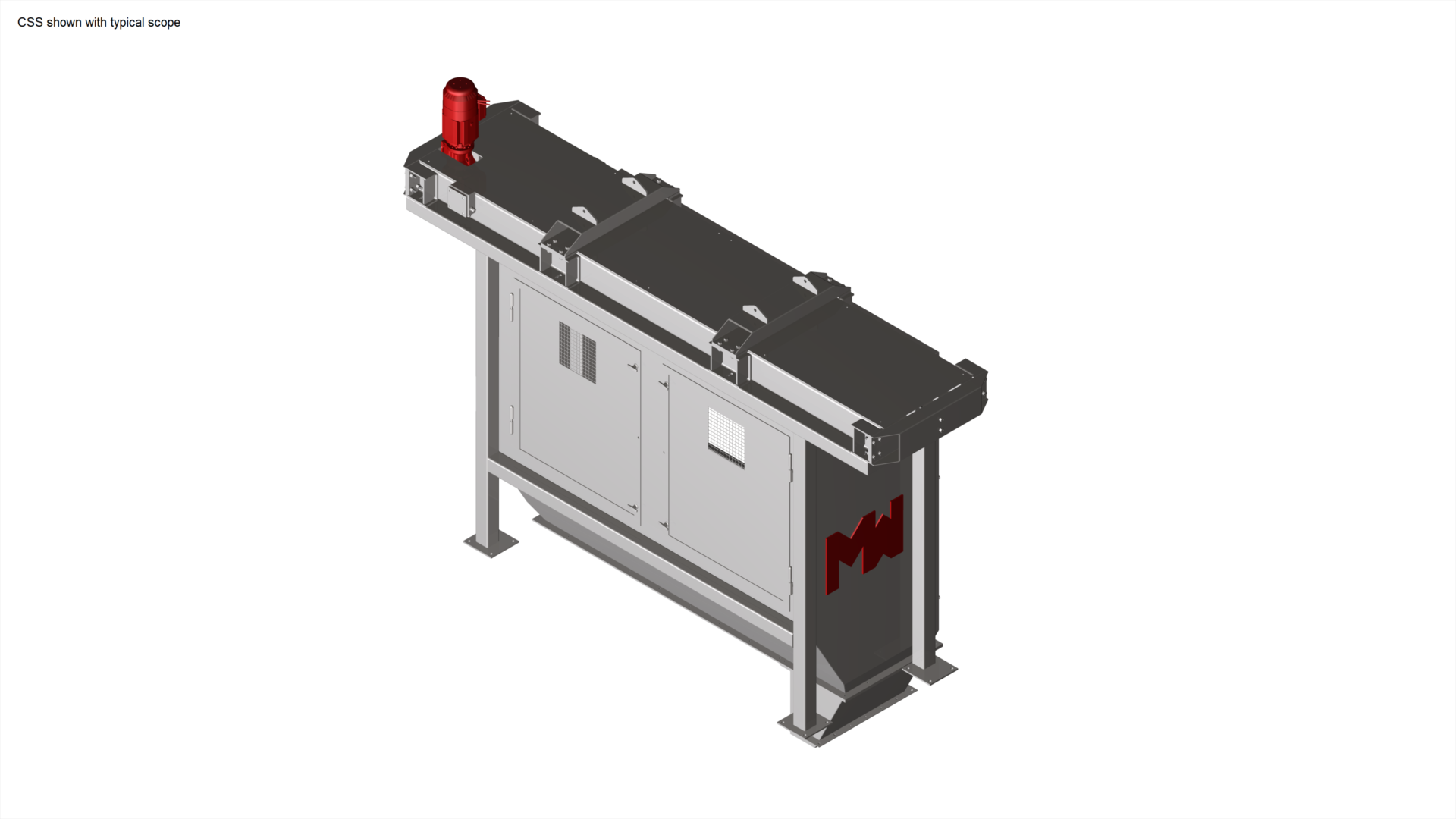
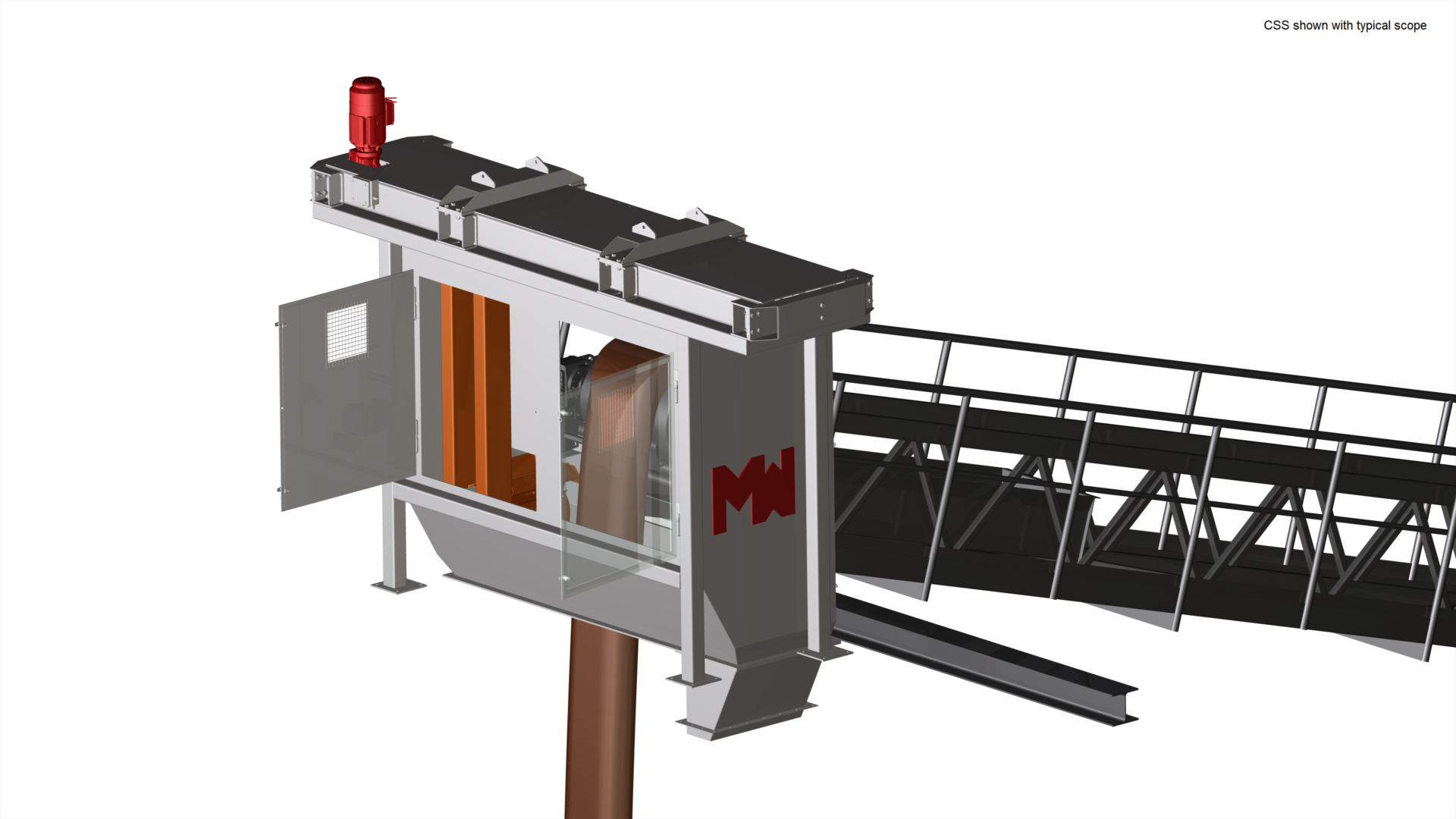


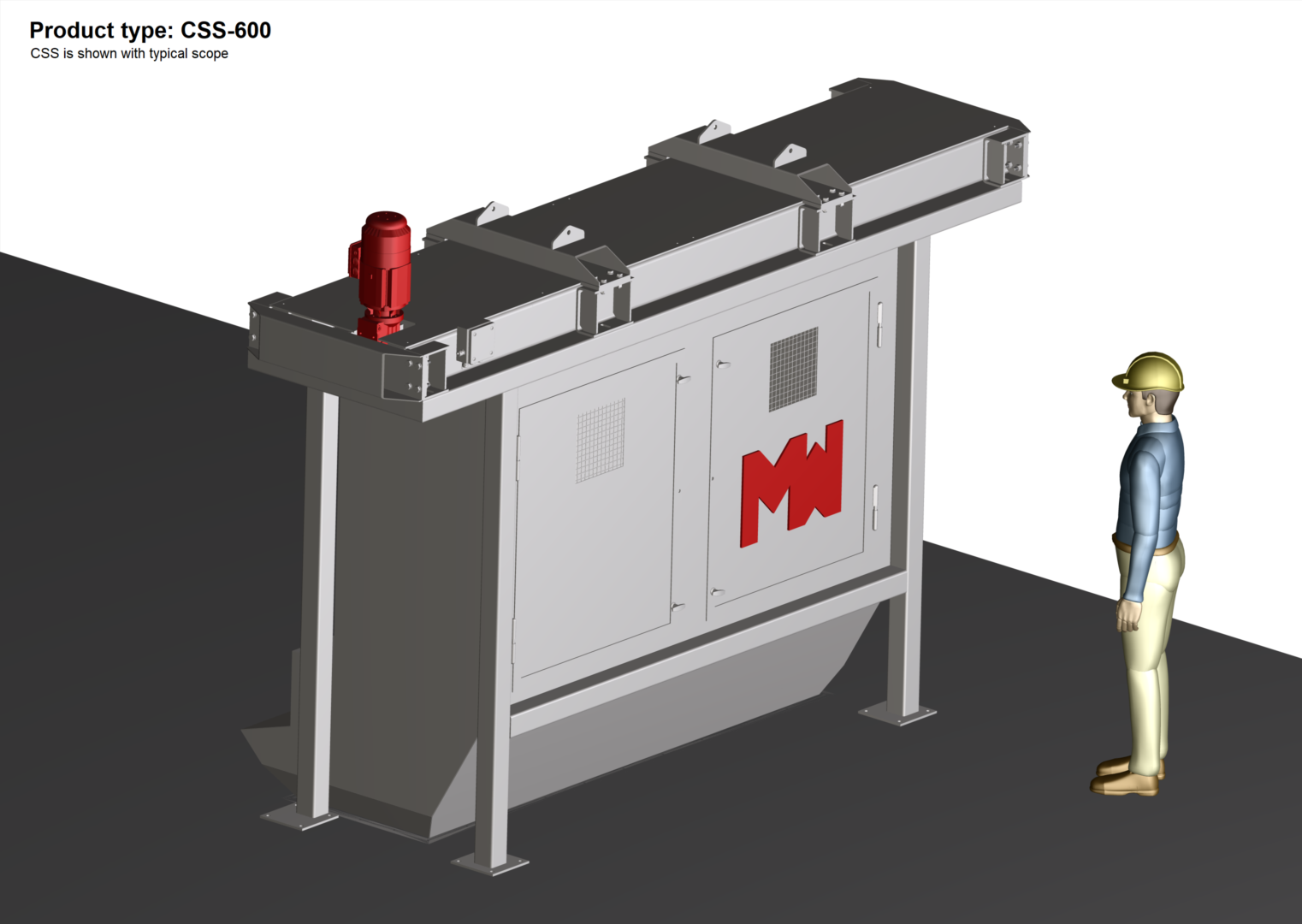


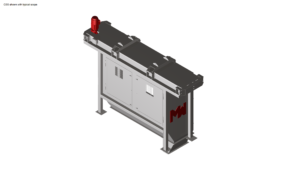
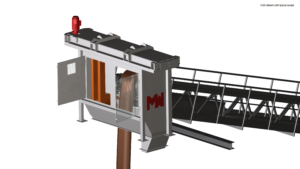


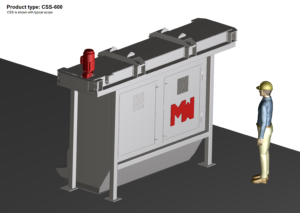
The Cross Stream Sampler (CSS) extracts a representative increment of bulk material from the free-falling stream at the discharge point of a conveyor belt. Representativity is achieved by cutting a complete cross section of the material stream, so every particle has an equal probability of entering the increment.
The CSS cutter travels through the entire cross section of the stream at a constant velocity, from entry to exit, so no part of the stream is skipped, and no particle size or density is favored over another.
This constant-velocity, full-stream cut is what makes the increment representative: every particle, regardless of size or density, has the same probability of being captured. Without it, a sampler introduces bias — a systematic difference between the material collected and the material the sample is meant to represent — that no laboratory can detect or correct afterwards, and every decision built on that number inherits the error. The CSS is designed to eliminate that risk at the point of extraction.
The CSS is a primary sampler, engineered to the specific conveyor, material and required increment mass. Depending on the process parameters, it can operate as a stand-alone sampler, delivering increments directly to a sample container, or as the first stage of a multi-stage sampling system.
It is available in two configurations — CSS Standard (CSS St) for 0.1 to 75 kg increments and CSS Heavy Duty (CSS HD) for 50 to 200+ kg increments — and can be supplied with a fully enclosed housing where dust containment, cross-contamination control and operator separation matter, helping ensure that the selected increment is protected from external pollutants and unintended material carry-over between sampling cycles, while dust is contained and personnel are kept away from moving components and the active sampling zone.
The carriage holds a constant cutting velocity of up to 0.6 m/s through the material stream, with acceleration and deceleration taking place outside the active sampling zone. This is consistent with established Theory of Sampling (TOS) design guidance for cross-stream samplers, where cutting velocity is set in relation to cutter aperture and particle top size. Keeping the velocity constant through the cut helps prevent the cutter from disturbing or preferentially deflecting part of the stream, so the increment is collected under the same defined conditions every time.
M&W JAWO Sampling equipment is engineered in accordance with the principles of TOS and applicable international sampling standards such as ISO, ASME, GOST and EN.
The CSS is installed at the discharge end of a conveyor belt, where material leaves the belt as a free-falling stream. At a defined interval, mass trigger or plant signal, a suspended sampling bucket passes through the full width and depth of that stream and transfers the collected increment to the sample outlet, either to a sample container or to the next stage of a multi-stage sampling system.
Where a suitable conveyor discharge point is available, the CSS provides the most representative primary-sampling geometry for material conveyed by belt. The bucket cuts the complete cross section of the free-falling stream at a controlled, constant velocity, rather than selecting material from the belt surface or only part of the flow. This gives all particle sizes, shapes, densities and moisture fractions in the stream an equal opportunity to enter the increment.

The full stream is available at the discharge point, so the increment is not limited to the top layer of the belt load. Segregation across the belt profile—coarse particles at the edges, fines in the middle and moisture concentrated at the bottom—is captured rather than ignored.
No cutter or sweeper works against the belt surface, reducing belt wear, the risk of belt damage and residual material on the belt as failure modes. Between increments, the sampling bucket is parked outside the material stream, and the sample outlet is positioned so the main material flow does not enter the sample path.
A primary sampler must address four requirements at once. The CSS is designed around all four.
Contact M&W JAWO Sampling to review your conveyor discharge point, material properties and required increment mass. We will recommend the CSS configuration and options that match your sampling duty.

For further information about the M&W Cross Stream Sampler, download the brochure here.

The CSS is a primary sampler that can operate as a stand-alone unit or as the first stage of a complete automated sampling system. It delivers each increment either directly to a sample collector or to downstream sample processing and preparation.
The primary increment establishes the basis for subsequent division, sample preparation and analysis. Depending on the material and required final sample, M&W JAWO Sampling can supply the remaining system stages: secondary samplers and dividers; crushing where particle-size reduction is required; material transfer equipment; sample collection; and control solutions. The result is a complete sampling and sample-preparation system designed around the application.
The CSS uses an integrated rail system that supports a suspended sampling bucket with a bottom-hinged discharge port. The carriage is driven by a chain-drive system and a gear brake motor mounted above the rails.
The motor controller holds a constant speed of maximum 0.6 m/s while the bucket passes through the falling material stream. The velocity is set for the specific duty and held constant through the cut; 0.6 m/s is the upper limit, not a fixed operating point.
Between increments, the sample bucket is held in a parking position outside the material stream. The sample outlet is positioned outside the main material flow, so non-sampled material does not fall into the sample. This keeps the bucket clear of the process stream and avoids unnecessary disruption to material flow.
When an increment is requested, the carriage transports the bucket through the falling stream with the bottom-hinged discharge port open, so process material passes straight through the bucket without being collected. At the turning point the discharge port closes, and the bucket collects the representative increment on the return pass through the stream. Acceleration and deceleration take place outside the active sampling zone, so the bucket travels through the material stream at constant velocity.
After the return pass, the carriage moves the bucket to the discharge position above the sample outlet. A mechanical release opens the bottom-hinged port and discharges the collected increment through the sample outlet. This completes the sampling cycle.
Hatches on top of the CSS frame give access for inspection and cleaning.
The CSS is used at conveyor discharge points where reliable data from bulk material is needed for quality control, process optimisation, inventory management or commercial settlement. The table below shows typical application areas and material streams. Final suitability depends on the material, material flow rate, particle top size and installation conditions.
Material flow rate and particle top size determine the CSS configuration and cutter geometry. Material characteristics determine the required construction materials and options:
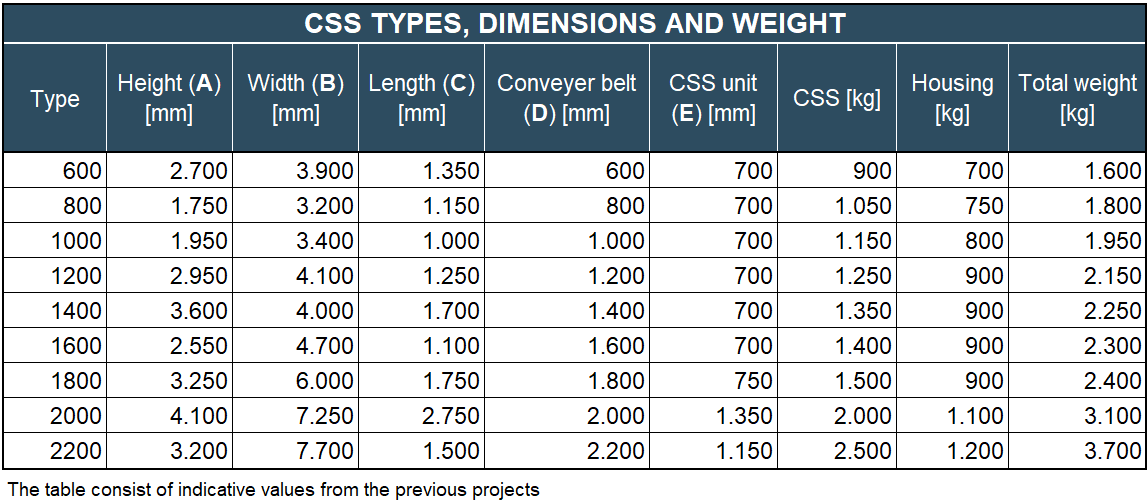
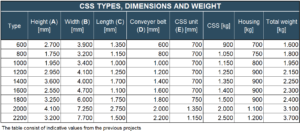
All dimensions and weights are indicative and based on previous projects. Final dimensions follow from the specific installation, and are confirmed during engineering.
Both configurations use the same sampling principle and deliver the same representativity. Selection is driven primarily by required increment mass, material flow rate, particle top size and installation conditions.
The CSS St covers increment masses from 0.1 to 75 kg. It is selected where the required increment mass, material flow rate and particle top size fall within its design range. It can be specified for abrasive materials and fitted with Hardox impact plates where required.
Required increment mass is determined primarily by material flow rate and particle top size. Belt width, sampling frequency, material abrasiveness and available space are assessed as part of the detailed design. Total weight ranges from approximately 450 kg for a 600 mm belt to 2,000 kg for a 2,200 mm belt including housing, which normally makes it easier to integrate into existing steel structures.
The CSS St provides a duty-matched solution where the required increment mass and installation conditions fall within its range.
The CSS HD covers increment masses from 50 to more than 500 kg. It is selected where larger increments are required, typically driven by higher material flow rates and/or coarser particle top sizes, and where the installation calls for larger mechanical capacity.
Typical indicators for the CSS HD are larger required increment masses, driven by higher material flow rates and/or coarse particle top sizes, as well as installations where unplanned downtime on the sampler stops either production or shipment documentation. Total weight ranges from approximately 750 kg for a 600 mm belt to 2,400 kg for a 2,200 mm belt including housing, so the supporting structure must be assessed as part of the project.
The CSS HD is specified where the required increment mass and installation duty call for the heavier construction.
Between 50 and 75 kg both configurations are technically possible. In that range, the decision is driven primarily by material flow rate, particle top size, installation geometry and support requirements. Contact M&W JAWO Sampling for clarification.
Both configurations can be supplied with the optional enclosure, the main support structure, the Hardox cutter head and the local control cabinet with HMI.
At the discharge end of a conveyor belt, where the material leaves the belt as a free-falling stream. The sampler frame is mounted above the discharge point and can be supplied with its own main support structure.
The sampling bucket cuts a complete cross section of the falling stream at constant velocity, maximum 0.6 m/s, so every particle in the stream has an equal probability of being included in the increment. This is the design requirement behind correct increment delimitation and extraction in the Theory of Sampling, and it is what prevents a systematic bias from entering the sample before it leaves the plant.
On the outward pass the bottom-hinged discharge port is open, so process material passes straight through the bucket without being collected. The port closes at the turning point, and the increment is collected on the return pass. This gives one defined cut per cycle and keeps unsampled material out of the sample.
The CSS Standard covers increment masses from approximately 0.1 kg to 75 kg. The CSS Heavy Duty covers approximately 50 kg to more than 200 kg. The correct configuration is selected primarily from the required increment mass, material flow rate and particle top size, alongside the installation and sampling duty.
Both use the same sampling principle and deliver the same representativity. CSS St covers 0.1 to 75 kg increments. CSS HD covers 50 to more than 500 kg increments and is selected where larger required increments are needed, typically driven by higher material flow rates and/or coarser particle top sizes. In the 50 to 75 kg overlap band, the decision is based primarily on material flow rate, particle top size, installation geometry and support requirements. Contact M&W for clarification.
Standard sizes cover conveyor belt widths from less than 400 mm to more than 2,200 mm. Each machine is dimensioned for the specific installation, so the frame width, height and depth follow from the conveyor and the available space.
Yes. Both CSS St and CSS HD can be specified for abrasive materials. The cutter head of the sampling bucket can be equipped with Hardox plates for increased wear resistance.
Dry, free-flowing and flowing bulk materials that leave a conveyor belt as a free-falling stream, including coal and coke, iron and other ores and concentrates, cement and clinker, limestone, fertilizers, biomass, chemicals, aggregates, recycled fractions and agricultural products. Very wet, sticky or bridging materials must be assessed individually, because build-up in the cutter opening narrows the effective cut and reintroduces bias.
Not always, but it is required where the material must be contained inside the sampler. The enclosure contains dust and fine particles, protects the sample against external pollutants and separates the working area from personnel during operation. Dusty materials such as biomass, limestone powder and cement normally justify it.
M&W can supply a local control cabinet with HMI, including motor feeder, frequency converter, PLC and interface for external communication. Where a control cabinet is not included, M&W typically supplies a control philosophy/logic description; M&W does not supply a control system in that case.
Routine inspection of the rail system, chain drive, carriage, cutter head and position switches, plus cleaning of the bucket and sample path. Hatches on top of the frame give direct access for inspection and cleaning, and wear parts such as Hardox cutter plates are replaceable.
Yes. Each CSS is dimensioned and configured from the customer’s production layout, conveyor geometry, material and required increment mass. This determines whether a standard CSS arrangement or a tilted CSS Standard (CSS-T) arrangement is appropriate. A main support structure can be supplied where required.
M&W JAWO Sampling equipment and sampling systems are engineered in accordance with the principles of the Theory of Sampling (TOS) and approved international sampling standards such as ISO, ASME, GOST and EN. The applicable standard for a specific delivery is agreed as part of the project specification.
Yes. M&W offers quantitative assessment of sampler performance on the customer’s own material, using analyses such as variographic or replicate experiments. This is the practical way to establish what the sampling regime actually delivers, rather than assuming it.
The CSS is the primary sampler. Its increment is normally passed to secondary division, crushing and sample collection stages, for example a divider, a crusher and a sample magazine with plastic or stainless steel sampling buckets.