Sample Magazine.

    The Final Step in Representative Sampling

    A primary sampler can collect the right increment, and that sample can be processed correctly — yet the result can still be compromised before it reaches the laboratory. Moisture loss, dust ingress, carry-over, overflow and sample mix-ups can turn good sampling into unreliable data.

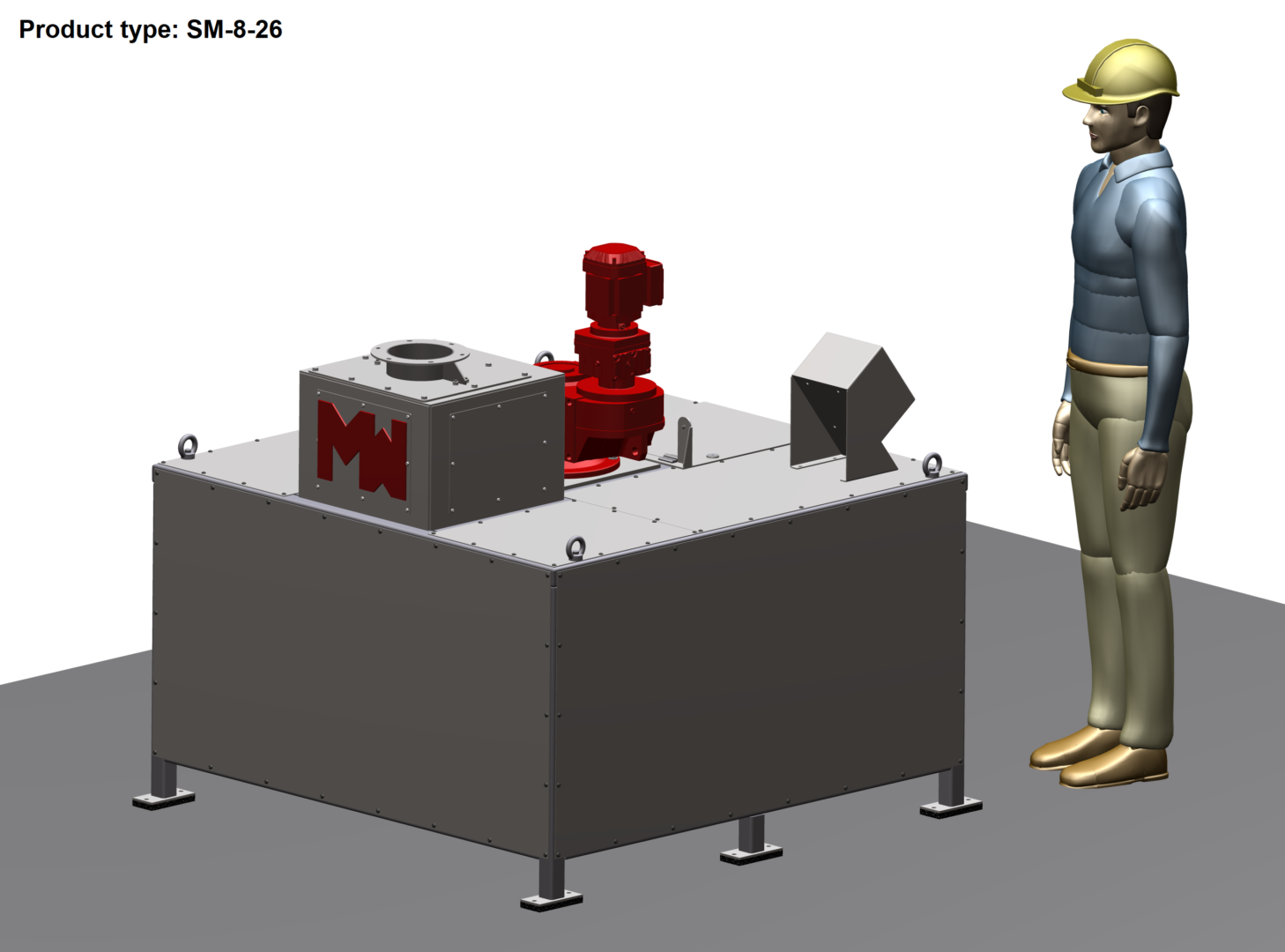
    The M&W JAWO Sample Magazine (SM) is the final collection and storage stage of an automated sampling system. It receives the sampled material, fills a dedicated bucket, keeps it inside a closed housing and indexes the next bucket automatically. Operators do not need to stand at the filling point.

    That matters commercially. A lost fine fraction can change particle-size distribution. Uncontrolled moisture exchange can affect a contractual result. An incorrectly labelled bucket can attach a correct sample to the wrong batch. The SM is designed to protect the sample after collection, when it may wait hours or even days before it is taken to the laboratory.

    What does the Sample Magazine do?

    Installed at the end of the sampling line, the SM receives material through a top-mounted inlet. Before filling, the selected bucket is raised towards the inlet. This closes the transfer gap so the increment enters the bucket rather than landing in the housing. After the assigned increments have been collected, the bucket is lowered, the carousel indexes and the next empty bucket is raised. In the tight version, each bucket is lifted and pressed against a gasket to maintain sealing during both filling and storage.


    Filled buckets remain inside the closed housing until an operator removes them through the access door. The safety switch deactivates the carousel before access is possible.


    RequirementHow the SM respondsCustomer value
    Protect the collected sampleClosed housing; tight version adds gasket sealing.Limits moisture exchange and exposure to dust, rain and foreign matter.
    Prevent material lossBucket is raised to the inlet before filling.Reduces spillage and loss of fines at the transfer point.
    Avoid carry-overEach sample is collected in a dedicated bucket.Reduces cross-contamination and routine container emptying.
    Keep sampling runningMultiple buckets are stored in sequence.Extends the interval between operator visits.
    Keep samples identifiableOptional RFID can identify buckets and connect them to sample data.Supports traceability and reduces manual labelling errors.

    What are the Sample Magazine benefits?

    FeatureWhat it meansBenefit
    Multiple buckets held inside the unitStandard configurations hold six to ten buckets in sequence. Other configurations available on request.Sampling continues across a shift, lot or campaign without changing a bucket after every filling.
    Bucket raised to the inlet before fillingThe transfer gap is closed during filling.Prevents spillage and loss of fines, protecting the sample’s particle-size distribution.
    Closed housingBuckets, carousel and filling point are contained inside an enclosure.Limits moisture exchange and exposure to dust, rain, wind-blown material and foreign matter.
    Tight version with gasket sealingBuckets are lifted against a gasket during filling and storage.Supports moisture-sensitive or contractual moisture determinations.
    Dedicated bucket per sampleEach sample or composite has its own container.Reduces carry-over and removes routine emptying between samples.
    RFID bucket identification (optional)Each bucket carries an electronic identity read at a defined point.Links the physical bucket to the correct sample record and reduces manual labelling errors.
    Batch tracking modeBuckets can be assigned to defined batches, vendors, grades or streams.Allows several streams through one installation without cross-mixing.
    Access door with safety switchThe carousel is deactivated before bucket access.Protects operators at the point where manual handling is required.

    Which sample collector to choose?

    M&W JAWO offers three collection concepts. The right choice depends on sample-integrity requirements, access during operation, storage capacity and whether interleaved samples are needed.


    ModelBest fitKey trade-off
    Sample Magazine (SM)When the sample must remain enclosed and protected during sampling, especially for dusty or hazardous materials, moisture-sensitive duties or longer unattended campaigns.Filled containers are removed through a safety-interlocked hatch; sampling is paused during removal.
    Linear Sample Magazine (SM-Li)When operators need to remove or replace filled bottles easily while sampling continues.Open and accessible design provides convenience, but offers less enclosure and protection than the SM.
    Dual Splitter (DS)When a simple, compact and cost-efficient two-container solution is sufficient, or when interleaved sample pairs are required to assess sampling precision and bias.Stores one container while the other is being filled; storage capacity is limited compared with SM or SML.


    In short: choose SM for maximum enclosure and sample integrity; SML for continuous access; DS for compact dual-container collection and interleaved sampling.

    Designed for your process.

    Every Sample Magazine is engineered according to the specific characteristics of the application, including:


    Process and material data

    • Purpose of sampling.
    • Nominal top particle size and particle size distribution.
    • Bulk density, moisture, dustiness, corrosiveness and other material properties.
    • Required sample size, lot definition and sample collection frequency.
    • Sample traceability requirements.


    Installation data

    • Available installation, inspection and maintenance space.
    • Sample integrity and work safety requirements.
    • Ambient temperature, dust, corrosion and hazardous-area requirements.
    • Electrical supply and control interface.


    Let us size it with you.

    Send us the required sample mass per lot, lots between operator visits, material properties, collection interval and available space. We will recommend the SM configuration, bucket type, sealing and identification method for your duty.

    Jan

    Jan Flemming Jørgensen

    Sales Director

    Download brochure


    For further information about the M&W JAWO Sample Magazine, download the brochure here.

    Sample Magazine Brochure Cover

    Where does it fit in the system?

    The SM is positioned downstream of the primary sampler and any sample processing and handling equipment. Filled buckets containing the final samples are then delivered to sample preparation or the laboratory.


    M&W JAWO Sampling can engineer the complete process — from primary sampling through secondary sampling, division, crushing and material transfer to sample collection and storage, including system automation and control. This ensures seamless integration of all interfaces, allowing the complete process to operate as a single, cohesive solution.

    How does the Sample Magazine do it?

    The Sample Magazine consists of a carousel carrying the sample buckets inside a closed housing, a top-mounted inlet, a bucket lifting mechanism and a drive motor, with a junction box and control interface.


    Cycle stepWhat happensWhy it matters for the sample
    IndexThe carousel positions an empty bucket beneath the inlet.The sample is directed to a known, assigned container.
    RaiseThe bucket is lifted towards the inlet opening.The transfer gap closes, limiting spillage and dust escape.
    FillOne or more increments are delivered into the bucket.The composite sample is built inside one dedicated container.
    LowerThe bucket is lowered clear of the inlet.The filled bucket moves into storage without disturbing the sample.
    StoreThe filled bucket remains inside the closed housing.The sample is protected until collection.
    CollectThe access door is opened, deactivating the carousel, and the bucket is removed.The operator is separated from the moving mechanism.


    In batch tracking mode, the carousel moves to the position assigned to the active batch, allowing several batches or material streams to be collected in parallel within one unit.

    Which industries use it?

    The Sample Magazine is used wherever an automated sampling system produces samples that must be stored, identified and transported without losing the properties that were sampled. Final suitability depends on the material, required sample mass, collection interval and installation conditions.


    IndustryTypical use case
    MiningComposite samples of ore, concentrate and coal where grade, moisture and settlement value must be supported by a traceable sample.
    Metals & Minerals ProcessingFeed, intermediate and product samples for grade control and metallurgical mass balances, including several streams through one collection point.
    CementLimestone, raw meal, clinker, pozzolana and additive samples in dusty plant environments.
    Energy & Power GenerationCoal, petcoke and biomass samples for as-received or as-fired quality determination.
    FertilizersNPK, potash, urea and phosphate samples where moisture can affect reported quality.
    ChemicalsGranulate, powder and by-product samples that must reach the laboratory unchanged and correctly identified.
    Precious & Base Metals RecyclingRecovered streams where grade determines settlement value and chain of custody matters.
    Laboratory & ResearchPilot and test installations where collection and handling must be repeatable and documented.


    What materials is it used for?

    Dry and moist free-flowing bulk materials including coal, coke, ores, concentrates, cement, clinker, limestone, fertilizers, biomass, chemicals, aggregates and recovered fractions. Very sticky or bridging materials require an individual assessment because build-up at the inlet or bucket rim can affect transfer and stored mass.

    What are the key specifications?

    FeatureAvailable configuration
    Equipment typeAutomated sample collection and storage unit for the final stage of a sampling system.
    Number of bucketsStandard configurations from six to ten buckets; other configurations available on request.
    Bucket volumeStandard configurations from 3.6 L to 120 L; other volumes available on request.
    Bucket typesPlastic Sampling Bucket (PSB) in HDPE for dry, free-flowing material at −25 °C to +60 °C;
    Stainless Steel Sampling Bucket (SSSB) for hot, wet, sticky, sharp-edged, dense or strongly abrasive material.
    Filling principleTop-mounted inlet; bucket raised to the inlet before filling to reduce spillage.
    IndexingAutomatic carousel indexing; sequential or batch-assigned positioning.
    ActuationPneumatic actuation as standard; electrical actuation available.
    ControlLocal control box with start/reset buttons and local/remote switch; control cabinet and plant-system interface available when included in project scope.
    SafetyAccess door with safety switch that deactivates the carousel before bucket removal.
    IdentificationManual identification or optional RFID configured for the required read point and traceability workflow.
    DimensionsDetermined by bucket volume and number – see examples below. Final dimensions and weight are confirmed during engineering.
    EngineeringEach unit is dimensioned and configured for the specific installation, sampling regime and material.


    Examples of dimensions and weights*

    TypeNo. of bucketsBucket size [L]Height [mm]Width [mm]Length [mm]Weight [kg]
    SM 8-3,683.68001,2001,300400
    SM 9-5951,1001,2001,200400
    SM 6-156151,0001,4001,700500
    SM 8-268261,5001,5001,500600
    SM 6-12061201,8001,8002,200900

    *Indicative values from previous projects


    Variants and options

    OptionDescriptionWhy specify it
    Tight version with gasket sealingEach bucket is lifted and pressed against a gasket during filling and storage.Protects moisture content where it is priced or specification-critical.
    RFID bucket identificationElectronic identification at the specified read point.Reduces manual labelling and supports documented chain of custody.
    Batch trackingDefined buckets receive material from defined batches or streams.Allows several consignments, vendors, grades or streams through one installation.
    Stainless Steel Sampling BucketSSSB supplied in place of the plastic bucket.For hot, very wet, sticky, sharp-edged, dense or strongly abrasive material.
    Local control cabinetControl cabinet with PLC and plant-system interface.Supports monitoring and documentation from the plant control system.

    Frequently asked questions about the Sample Magazine

    • Functionally, yes. These terms describe equipment that fills, stores and often identifies sample containers at the end of an automated sampling system.

    • Standard configurations range from six to ten buckets and 3.6 to 120 litres. The SM is custom-designed, so other quantities and volumes can be considered for the duty.

    • Yes. Batch tracking can assign defined buckets to defined batches, vendors, grades or process streams. The carousel then indexes to the assigned position.

    • Samples can be identified manually or with optional RFID configured to the required read point and data workflow. RFID can link the physical bucket to the relevant sample, batch, shift or laboratory record.

    • The SM access door is safety-interlocked and the carousel is deactivated before access. Sampling is therefore paused during bucket removal; if continuous access is required, consider the Linear Sample Magazine (SM-Li).

    • It is intended for dry and moist free-flowing bulk materials including coal, coke, ores, concentrates, cement, clinker, limestone, fertilizers, biomass, chemicals, aggregates and recovered fractions. Very sticky or bridging materials require individual assessment.

    • Usually it can, provided the sample route can be directed to the inlet and sufficient floor area and access clearance are available. Final suitability is confirmed from the layout and sampling regime.

    • The applicable international sampling standards are agreed in the project specification. The equipment is engineered according to TOS principles, international sampling standards and other guidelines relevant to the delivery.